


I want to be upfront about something before you read a word of this comparison: I am not a neutral party.
I was AlterG’s first employee and spent years helping build the sports side of the business, including starting their international office in London. After nearly a decade, I left and co-founded Boost with Sean Whalen (who originally founded AlterG) and Jimmy Bean, who ran AlterG's commercial and military sales.
All that to say, I’ve been on both sides. My goal here isn’t to give you a polished, brochure-style comparison. Everything written below is what I’d actually tell you if you picked up the phone and asked me directly. And if you do want to talk it through, feel free to call — my number is at the bottom. Or for a quick side-by-side breakdown, you can view our full comparison chart here.
Where it all began
Sean founded AlterG in 2005 in Los Altos, California, building on differential air pressure technology his father Dr. Robert Whalen had developed at NASA's Ames Research Center. I joined as the first employee and helped grow it from there. The first unit sold to the Washington Wizards in 2007. Within a year, dozens of NCAA, NBA and NFL organizations had followed. It was a genuinely exciting company to be part of in those early years.
What started as a genuine mission — bring this technology to the mass market, to the people who actually needed it — got sidetracked the way things do when outside money starts setting the agenda. We had investors, nine CEOs in twelve years, development stalled, and the original vision got lost somewhere in the shuffle.
Sean and I left AlterG in 2015. We spent a couple of years working on other projects, but we kept coming back to the same conversation: could we do this better? We thought we could. And so we co-founded Boost in 2017.
The frame we started with was accessibility. When we left AlterG, their Pro model was over $85,000. We thought that was fixable. We also thought the machines could be easier to get on and off, easier to control, easier for clinicians to teach patients to use independently, and easier to maintain and service. None of those were small ambitions. But they were the right ones, and they've driven almost every engineering decision we've made since.
The Common Ground
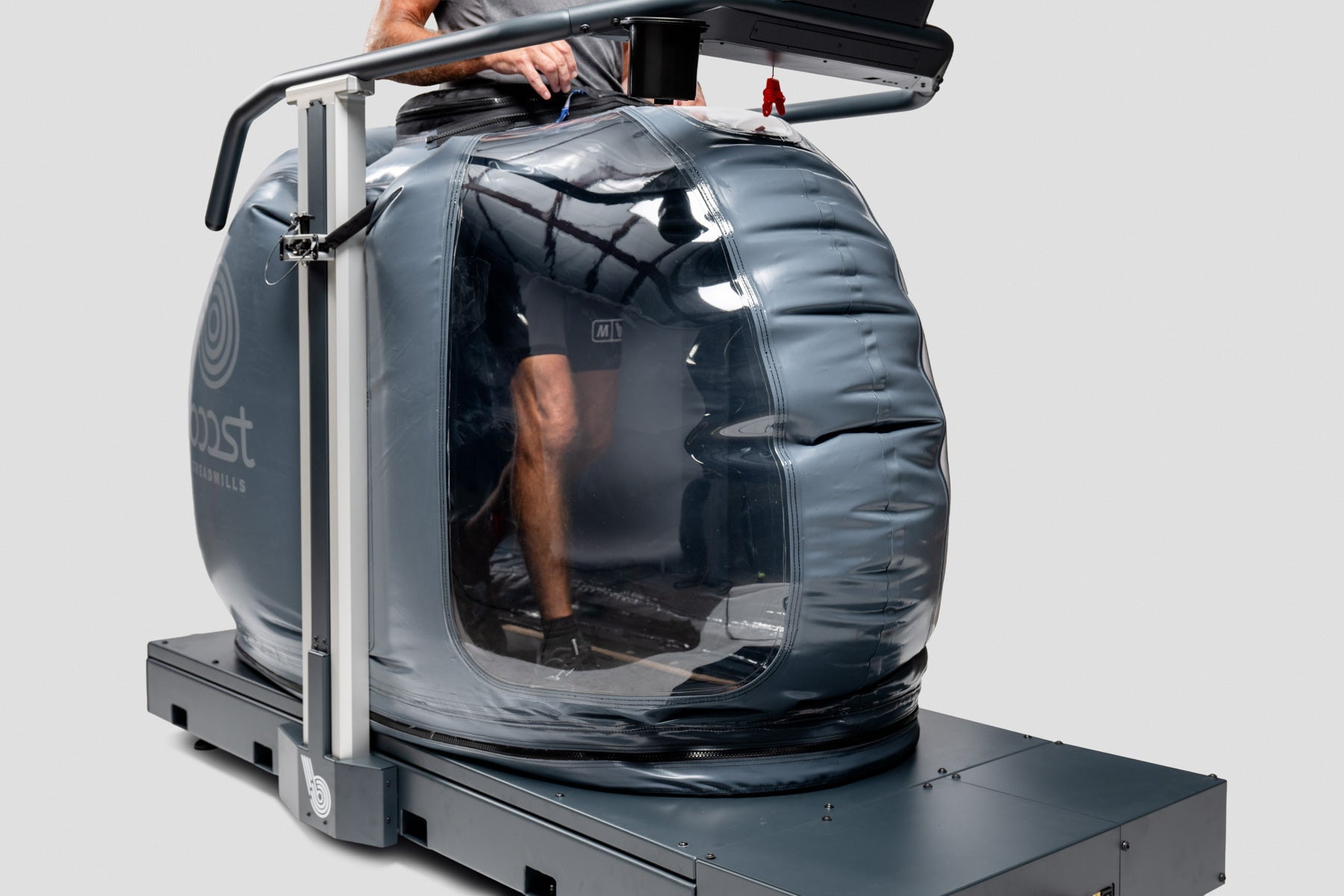
Both products use Differential Air Pressure (DAP) — the pressurized lower-body chamber that creates a lifting force and reduces effective body weight during walking or running. The core mechanism traces back to the same source: Dr. Whalen's work at NASA Ames. Sean commercialized it at AlterG, and he's been reinventing it now at Boost.
The actual feeling of unweighting is very similar across all of these products. If you’ve used an AlterG and seen it work for your patients, that experience carries over. What changes is everything around it — the noise, the setup, the controls, the platform, the service. But the fundamental sensation of walking or running at reduced body weight is shared heritage, and it is genuinely remarkable.
How the engineering differs and why it matters in practice
Methods of managing air pressure
This is one of the more technical differences, but it has real consequences for daily use.
AlterG's system runs a blower continuously at full output and uses a valve to release air when the pressure inside the chamber exceeds the target. You're venting the excess through a small opening constantly. That creates two problems: it's loud — because the powerful blower is running at full blast all the time — and there is more wear and maintenance from additional moving parts.
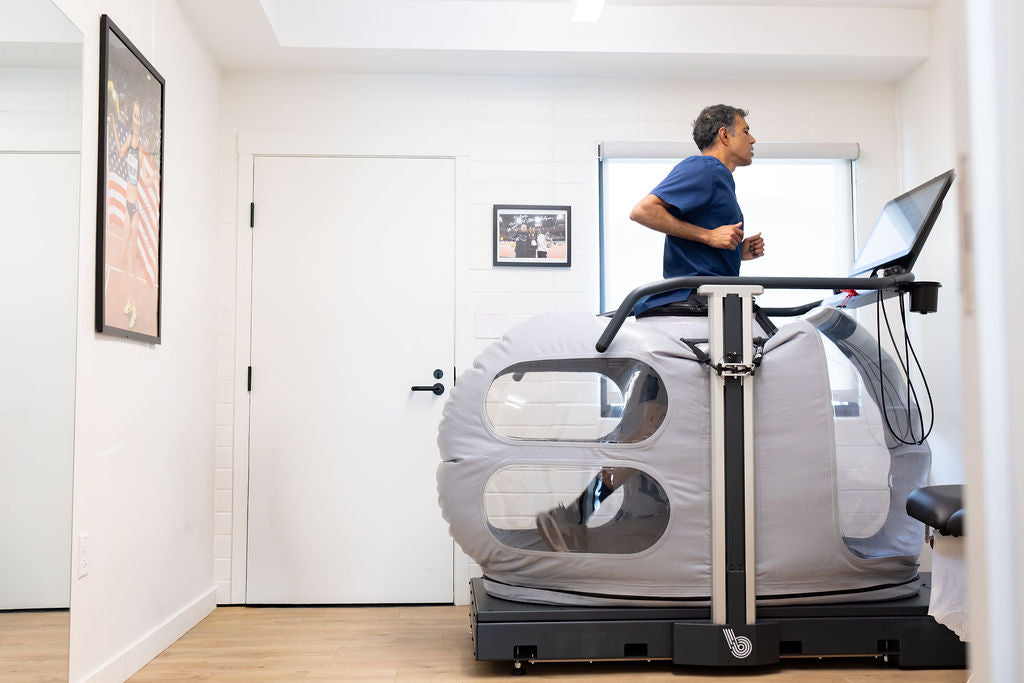
The Boost works differently. Rather than running at full output and releasing the excess, we modulate the blower itself — turning it up and down in small increments to maintain constant pressure. We also use a small, controlled leak built into the system to bring pressure down when needed. The result is a system that's dramatically quieter, and one that has no moving parts other than the blower motor itself which means far less to wear out or fail.
For a PT clinic running 20–30 sessions a day, those differences matter. Noise affects therapist/patient communication during sessions, especially when multiple treatment areas are sharing space. And from a maintenance standpoint, a system with fewer moving parts simply has fewer things that could eventually require service.
Calibration
Both the AlterG units as well as our Boost 2 and Boost 3 Treadmills calibrate for their specific users, just through different methods. The key to understanding calibration on a microgravity treadmill is that it’s not just user weight that affects the amount of pressure needed to take you to a certain body weight. Waist size is also crucially important, because the air pressure is pressing across a cross section of the lower body. The larger the surface area, the less pressure needed to lift. Think of it this way: a bigger wing on an airplane will create more lift on the plane.
So we take three pieces of information from you: height, shorts size (used to calculate your cross sectional area) and a weight range (within 5 lbs). We then use those parameters to create a calibration curve for you that also estimates the amount of pressure it will take to get you to a desired body weight.
Both treadmills use different methods to get to the same outcome of bodyweight percentages within 2-5% of the desired weight, controlled in 1% increments. I think ours is better, and I'll tell you why. First: it's completely repeatable. Every time a user gets on the machine and enters the same information, the calibration will be the same. Slight movements on an AlterG can shift the calibration. Second: it's instant. Enter height, shorts size and weight which takes about 10 seconds and you are good to go. The AlterG calibration process takes about a minute.
All that being said, I think that both systems work really well and ultimately get you to the same place.
Getting in and adjusting height
AlterG uses a manual height adjustment where the clinician physically lifts the frame to set the height before the patient gets in. The problem is that in practice, most people set it too high because it can be difficult to adjust precisely. However, a chamber that's set too high changes the contact angle between the patient and the air seal, and that affects gait mechanics in ways that undermine the whole point of the session.
The Boost uses a motorized height adjustment system that sets automatically based on the user's height input. That means every patient is getting the correct chamber height every time. This matters because correct chamber height is a prerequisite for normal gait mechanics—if it’s off, patients begin to compensate and you’ll see changes in arm swing, posture, and overall movement quality.
There's also a downstream benefit that clinics tell us about constantly: when height sets itself, you can train a patient to get on the machine once and after that they can use it independently. For clinics that want patients to warm up or cool down on the treadmill, or use it between PT sessions, this is a significant practical difference. It turns the machine into something patients can operate themselves rather than something that requires a clinician every time.
The treadmill underneath the technology
AlterG's PRO model is built on a foreign-made OEM treadmill base. The Woodway 4Front base included in Boost 2 models costs five to ten times more, and that gap is not incidental. Woodway’s treadmill platforms are used at professional sports facilities, Olympic training centers, and major research universities. Their slat-belt design reduces impact at foot strike, runs quietly, and is built for decades of daily commercial use.
For a clinic that expects to run this equipment hard for 10-15 years, the platform underneath is not a spec to skim past. It's the foundation everything else depends on.
Pricing
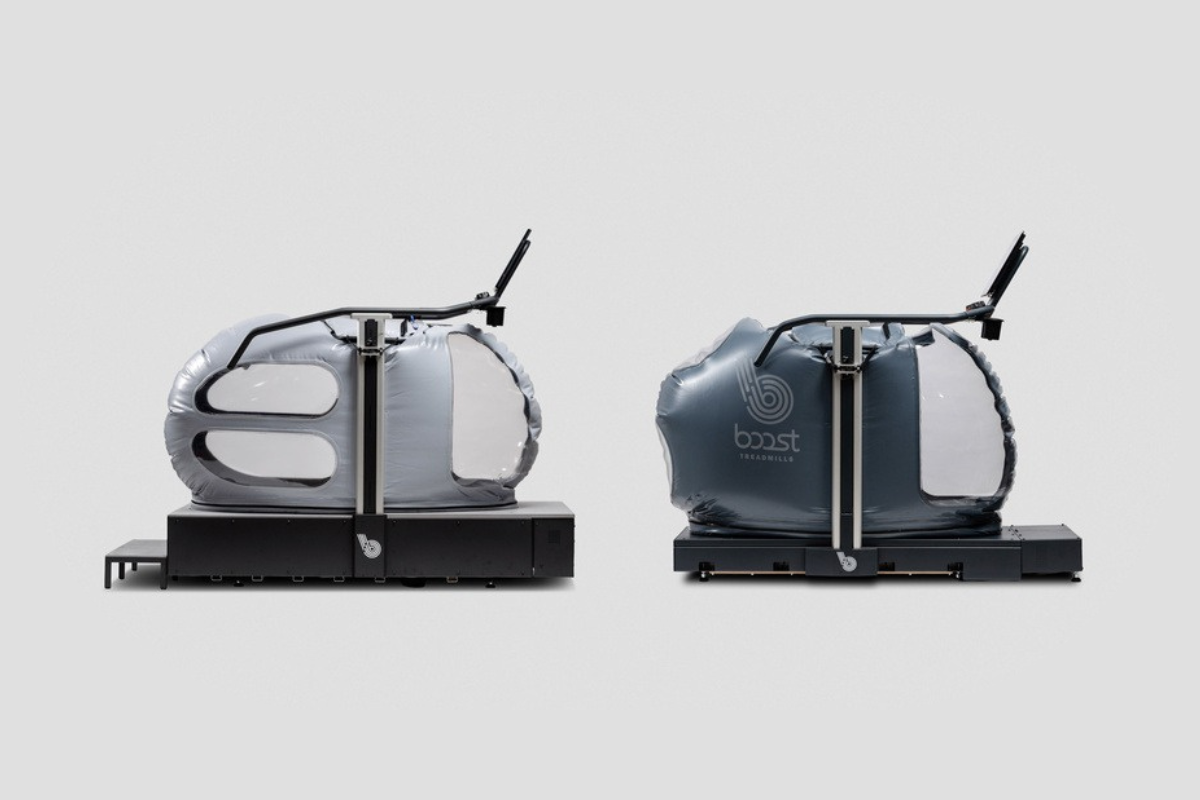
The Boost 2 Core is $37,500 and the Elite is $44,900, with $5,000 for shipping and installation on top of that. The AlterG PRO is $45,900 plus roughly $4,500 in shipping and installation — so the two products land at a comparable all-in number.
What you're getting for that number is very different. The AlterG PRO is built on essentially the same frame we designed back in 2005 — manual setup, highly manual to operate, and now paired with a lower-end OEM treadmill. The Boost 2 is a ground-up redesign with motorized height adjustment, precise pressure control, and a Woodway slat-belt platform underneath.
Our Boost 3 model improves on this. The core technology and structure is the same, but with a smaller footprint and significantly lower cost (see full comparison here). In the US the Boost 3 is $24,999 with rentals from $499/month for your home and $599/month for commercial facilities.
Where AlterG has a genuine advantage
I said I'd be honest, so here it is.
AlterG offers an integrated gait analysis system with a camera on some of their treadmill models. If on-screen gait mechanics feedback is a specific clinical priority for your program, AlterG is currently the better option for that feature.
However, it only works at walking speeds (not running). And the information it provides is basic; not the kind of detailed biomechanical analysis that would replace a dedicated gait lab or purpose-built gait analysis software.
We don't offer integrated gait analysis at Boost, because it’s not where our expertise lives and I'd rather acknowledge that honestly than fold something mediocre into the machine. What our customers do instead — including a number of the highest-volume clinical programs using our treadmills — is pair the Boost with third-party gait analysis tools. That gives them more capability than the AlterG integrated system at walking speeds, and it works at running speeds too.
But if you specifically need the integrated camera system and on-screen feedback as part of your workflow, that is a real differentiator for AlterG.
The service question
This is the one I feel most strongly about.
AlterG, now operating as part of Lifeward, has discontinued support for multiple legacy product lines. Clinics that purchased AlterG units in good faith are finding that replacement parts carry 6-8 month lead times. A non-functional treadmill in a PT clinic means cancelled patient appointments, interrupted rehabilitation protocols, and real harm to real patients.
I don't say that to be unkind to a company I spent years building — I say it because it's the most practically important factor in this decision, and it almost never gets the weight it deserves when facilities are evaluating equipment.
Boost is founder-led. Sean has been engineering these systems since before the first one shipped. When something goes wrong with a Boost (and things inevitably do go wrong with equipment at times) you're working with a team that has a direct personal stake in getting it resolved. We maintain in-stock parts and we take service seriously because downtime affects your clinic. Support isn’t an afterthought for us, it’s part of the product. If you’re evaluating long-term support and service, we’ve written more about how we approach that here.
What I'd tell a friend
If someone I knew was opening a PT clinic and asked me what to buy, I'd tell them to buy a Boost. Better treadmill platform, quieter, more precise pressure control, automatic height adjustment that actually protects gait mechanics, lower all-in cost at the premium level, and better service and parts availability. And for what it's worth: the technology in a Boost was built by the same team that invented this category. Sean has been engineering DAP systems for twenty years. We didn't leave AlterG to build something worse.
I'm biased and I will own that; but I also believe in the facts. If you want to talk through any of this directly, feel free to give me a call at 510-333-3718 or contact us and we'd be happy to chat more! If you want to compare everything on your own side-by-side, you can view the full chart here.

Why Clinics Are Choosing the Boost 3
Who We Are & What We Believe